

Macular degeneration is a disease that develops in the retina, the light-sensitive tissue lining the back of the eye. As macular degeneration progresses, it robs us of the clear central vision we need for everyday activities.
There is currently no cure for macular degeneration. At Vista Eye Specialists, our experienced doctors carefully evaluate patients with suspected AMD and refer them to specialists in the disease when needed. With medical and surgical therapies, macular degeneration can often be managed to help delay or prevent vision loss.
What Is Macular Degeneration?
Macular degeneration is a breakdown of the macula, or central portion of the retina responsible for clear central vision and most of our color vision. A healthy, functioning macula is essential to our ability to read fine print, recognize faces and see sharp color tones. The macula contains a large amount of photoreceptor cells that create signals from light to send to the brain. At the edge of the retina are rod cells, which help maintain peripheral and color vision.
Macular degeneration is often referred to as “AMD” (age-related macular degeneration) because it is most common among older adults. Persons 55 and older are at greatest risk of developing the disease.
Other risk factors include a family history of the disease, poor diet, smoking and overexposure to sunlight.
What Are the Signs and Symptoms of AMD?
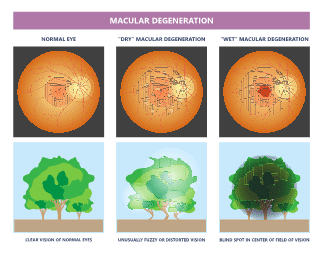
As the cells of the macula gradually break down and die, central vision can become blurry or shadowy. Dark spots may appear in the central line of sight, and straight lines can appear wavy.
As AMD progresses, vision continues to deteriorate. The center of the visual field can become very distorted. Other signs and symptoms of AMD can include loss of contrast sensitivity, impaired depth perception and the need for brighter light to perform daily tasks.
Vision continues to deteriorate as the disease progresses. In the most advanced cases, macular degeneration can render a person legally blind.
Types of AMD
The early stage of AMD, called “dry AMD,” affects approximately 85-90% of people with the disease. With dry AMD, small yellow deposits called drusen form under the retina, causing it to thin, dry out and lose function. Vision loss can occur.
Dry AMD tends to advance more slowly than the other type of AMD, which is known as “wet AMD.” With wet AMD, abnormal blood vessels grow under the retina and macula, leaking blood and other fluids; the leaking can collect and cause a bump in the macula. This causes central vision to deteriorate quickly.
Treatments for AMD
Treating dry AMD usually involves nutritional therapy to promote macular health. The National Eye Institute’s Age-Related Eye Disease Study (AREDS) and its follow-up, AREDS2, discovered that consuming certain nutrients — including lutein and zeaxanthin — can delay or prevent the progression of dry AMD to wet AMD.
Treatments for wet AMD include injecting medication into the eyes to inhibit the growth of new, abnormal blood vessels. Photodynamic therapy and laser surgery can also be used to seal off and destroy abnormal leaking blood vessels. These treatments generally don’t restore lost vision but they can help delay or prevent additional vision loss.
Macular Degeneration FAQ
Age-related macular degeneration typically affects both eyes, but it is possible the eye disease may start in one eye and then progress to affect the other eye as well. Someone with unilateral (one-sided) AMD is more at risk of it becoming bilateral. Dry AMD is more difficult to discern early on and may affect one or both eyes, with the good eye compensating for the weaker, diseased eye. The patient may not realize something is wrong until there are significant vision changes.
The bottom line: It’s more common for AMD to be bilateral or affect both eyes. The disease may not progress at the same pace in each eye, and it’s possible to develop dry AMD in one eye and wet AMD in the other.
An Amsler Grid is used for diagnostic purposes. Your doctor may have the patient use one at home to check for gaps or distortions in their vision. This sheet of paper has a printed grid of lines the patient holds at a reading distance in a well-lit room. One eye is covered at a time, and the patient focuses on the black dot in the middle of the page. A patient with macular degeneration may see wavy, fuzzy, distorted or dim lines in the middle of the grid sheet.

A family history of macular degeneration is the most substantial risk factor for developing this eye disease. Ask your relatives about their eye health and your ancestors’ health to determine if you have a history of AMD in your family. People most at risk have a genetic link to AMD, are over 60, smoke cigarettes and are overweight or obese. High blood pressure is another significant risk factor for macular degeneration. Overexposure to ultraviolet (UV) light or blue light may increase the chances of getting AMD, and people of Caucasian descent may be more likely to develop the eye disease.
Patients can lower their chances of developing AMD with lifestyle changes, such as eating a better diet, exercising more often and quitting smoking. However, family history is out of your control. If you have these risk factors, talk to our doctors and discuss any sudden or noticeable vision changes immediately. Your doctors may suggest you look at an Amsler Grid regularly.
Like most conditions, the earlier you’re diagnosed with AMD, the better your chances of preserving your remaining vision. Specific treatments for AMD can stop or slow vision loss and disease progression. Early diagnosis is possible by understanding your risk factors and family history and having regular comprehensive eye exams at Vista Eye Specialists.
Regular eye exams can catch minor changes that patients don’t realize are there because early stages of AMD damage the eyes without noticeable symptoms. Straight lines start to appear wavy, and then you may develop blank or dark spots in your central field of vision, which worsens until only the peripheral vision remains clear.
AMD Diagnosis in Fredericksburg and Culpeper, VA
If you are experiencing blurry or distorted central vision, you should be checked by an eye doctor for macular degeneration or other eye diseases. Our team can assess your eye health and provide a referral to a leading AMD expert. Contact Vista Eye Specialists at 888-393-5264 to request an appointment.