

Comprehensive eye exams at Vista Eye Specialists are vital to maintaining optimal eye health. Our experienced team of eye care experts uses state-of-the-art technology to comfortably evaluate your eyes while protecting both your eye health and vision.
Why Comprehensive Eye Exams Are Important
Regularly undergoing eye exams are crucial for detecting vision problems like nearsightedness, farsightedness, or astigmatism and determining if you may need glasses or contact lenses.
They can also reveal eye conditions such as cataracts, macular degeneration or glaucoma in their early stages when they are easier to treat.
Additionally, eye exams are beneficial for your overall health, as they can sometimes offer early clues to health conditions such as diabetes, high blood pressure, and certain forms of cancer.
The experienced eye doctors at Vista Eye Specialists provide thorough eye examinations for patients of every age. Our dedicated family eye care team will recommend how frequently you should schedule exams, taking into account your health, vision requirements, age, and family history.
What to Expect During Your Eye Exam
During your eye exam, your doctor will ask you questions regarding your full medical history, including your eye health. You will also be asked to describe any vision problems you may be experiencing. Your eye exam will consist of a variety of eye tests to evaluate your eye health.
You should plan on spending one to two hours at our office. Our doctors will determine the right tests for you based on your medical history and needs, so that we have a thorough and accurate evaluation of your eye health. Your eye exam may include any of the following tests:
- Retinoscopy – uses light reflexes from your eye to approximate your glasses or contact lens prescription. (Discussed in more detail below.)
- Refraction – fine-tunes your eyewear prescription by showing you a series of lens choices. This test helps determine your level of nearsightedness, farsightedness, astigmatism and/or presbyopia.
- Auto refraction – evaluates the way an image is focused on your retina (the back portion of the eye where vision processing takes place) by stabilizing your head on a chin rest while you look at a pinpoint of light or another image.
- Cover test – involves covering your eyes one at a time while you focus on a small object at a distance, so that the doctor can observe the movement of the eye. This test helps detect strabismus, poor depth perception, and other binocular vision problems.
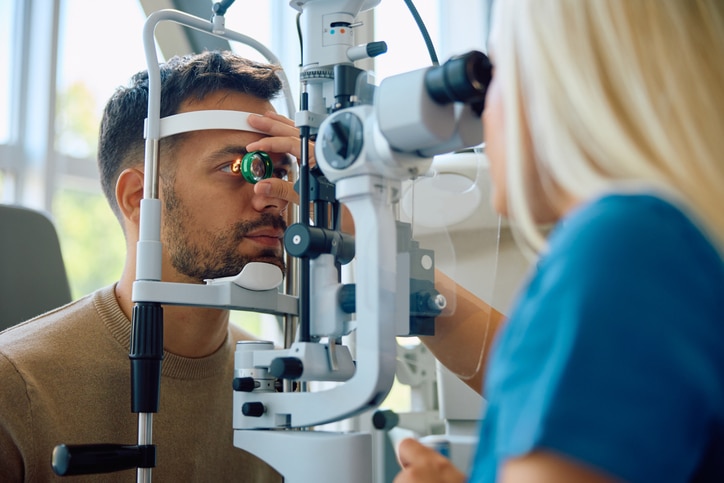
- Slit lamp exam – examines the health of your eyes by allowing the doctor to get a highly magnified image of the structures of the eye in order to thoroughly evaluate them for signs of infection or disease. As you rest your head on a chin rest, the doctor shines a light at your eye and looks through an ocular microscope to examine each part of the eye, including the front structures (lids, cornea, conjunctiva, iris, etc.) and the inside of the eye (retina, optic nerve, macula, etc.). This test helps detect a whole range of eye conditions and diseases, including cataracts, macular degeneration, glaucoma, corneal ulcers, diabetic eye disease and more.
- Glaucoma intraocular pressure measurement – determines your intraocular pressure. The doctor will anesthetize your eye with a yellow/green drop and then manually determine your intraocular pressure by using a blue light instrument near the front of each eye.
- Visual field test – detects blind spots in your peripheral vision. Blind spots can originate from eye diseases, like glaucoma, or develop from brain damage caused by stroke or tumor.
- Dilation – drops are used to make the pupils larger in order for the doctor to get a better view of the internal structures of the eye using a variety of instruments and lights. During this time, your eyes will be sensitive to light and you will have difficulty focusing on objects. Dilation takes about 20 minutes; however, the effects can last up to several hours. Therefore, sunglasses should be worn to minimize glare and light sensitivity on your way home. If you may feel uncomfortable driving after dilation, please bring a driver with you.
Checking for Refractive Errors
Refraction is the manner in which light passes through the eye’s clear front covering (the cornea) and lens. A refractive error refers to a problem with the way light passes through the eye and focuses on the retina; these errors occur when the cornea or lens is not evenly or smoothly curved, preventing light from focusing directly on the retina.
Nearsightedness occurs when light rays focus in front of the retina, causing close objects to appear clearly while faraway objects appear blurry. Farsightedness occurs when light rays focus behind the retina; faraway objects come into focus clearly but nearby images do not. Astigmatism occurs when light rays do not focus evenly on the retina, and both nearby and faraway images can appear blurry or distorted.
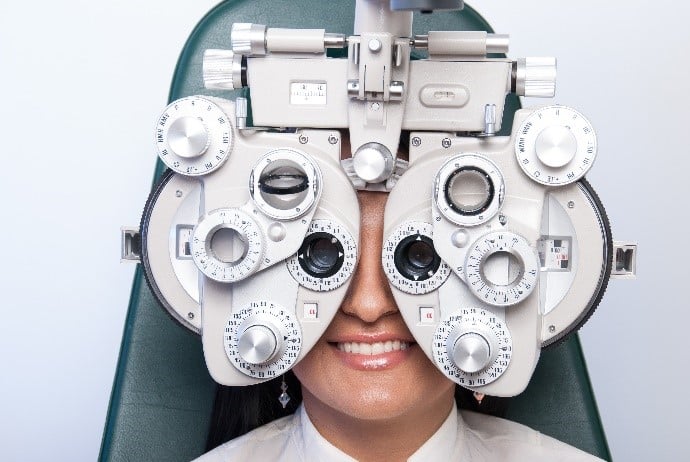
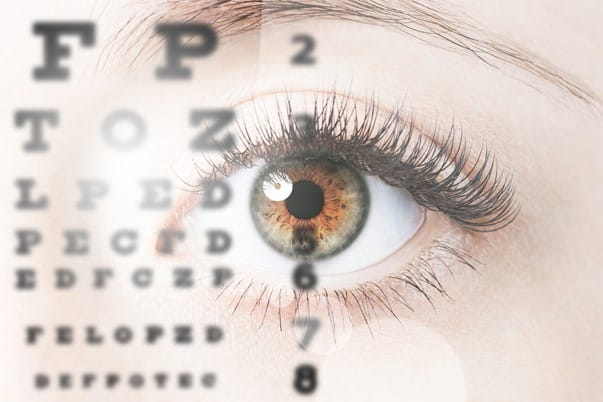
Our eye doctors use a technique called retinoscopy to measure refractive errors; during this test, the doctor shines a light into the eye and evaluates the movement of the light reflected by the retina. A phoropter — a mask-like device with multiple lenses mounted onto a wheel — may also be used to fine-tune the prescription. You will be asked to look through the different lenses and focus on an eye chart; the doctor will ask you which lenses give you the clearest vision. All of this information can help the doctor provide the eyeglass or contact lens prescription most likely to give you the best visual acuity.
Eye Exams for Updating Your Contact Lens Prescription
If you wear contact lenses, please bring a copy of your prescription (or a box of your contacts) to your eye exam. We will evaluate your vision with contacts and determine whether you need a prescription change. We will also look at the front of your eyes for any changes that may have been caused by wearing contacts, and make adjustments as needed.
If you currently do not wear contact lenses but would like to, you will need to have a special exam and fitting. Your eyeglass prescription and contact lens prescription are not interchangeable.
During the contact lens exam and fitting, several things will happen:
- We will discuss your contact lens options, including soft lenses, rigid gas permeable lenses, daily disposable and overnight wear lenses.
- We will measure the curvature of your cornea (the clear front surface of your eye) to help us select the appropriate curve and size of your contacts.
- We will measure your eye’s pupil and iris to ensure well-fitting contacts.
- We may evaluate your tear film, noting how many tears you produce and how long it takes for them to evaporate. This can help to determine whether you can wear contacts comfortably and if you have dry eye, the type of lens that is best for your eyes.
- We will have you try on a pair of contacts and evaluate your cornea using a special microscope to look at the alignment and movement of the lenses.
Once we determine the appropriate lens for your refractive error and the anatomy of your eyes, we will write you a prescription for the appropriate power, shape and diameter of the lenses that are right for you. You will wear these lenses for a few weeks as a trial and then have a follow-up exam to discuss making any necessary adjustments.
Eye Exam Frequently Asked Questions
During an eye exam, your eye doctor looks for any new vision problems you may be experiencing as well as changes to any existing vision problems. The doctor also takes a thorough look at the internal structures of your eye to check for any abnormalities or signs of disease. Looking at structures such as the retina and optic nerve can provide clues about your overall health. For example, irregularities affecting the tiny blood vessels of your retina may suggest diabetes or blood pressure problems.
A vision screening is a basic check to confirm or rule out problems affecting vision. Vision screenings are usually conducted by untrained personnel and involve very limited testing with minimal equipment.
On the other hand, an eye exam is considerably more comprehensive and can diagnose specific visual problems. Eye exams also look inside the eye at the visual system and evaluate the health of the eye. Eye exams are performed by ophthalmologists or optometrists, and involve various pieces of equipment, tests, and procedures.
Be sure to bring your eyeglasses and contact lenses to your exam, as well as a list of any medications you take. Depending on the type of eye exam you will be having, check with your eye doctor to see if you need to be out of your contact lenses for any period of time before your eye exam. Also, dilating your eyes can make them sensitive to sunlight, so we recommend bringing a pair of sunglasses to wear on the drive home. If you prefer to not drive after having your eyes dilated, please bring a driver with you.
No, eye exams are not intrusive or uncomfortable. Our team works hard to make the exam as pleasant as possible. You may be asked to look at a bright light for a few moments. As mentioned, dilating your pupils can make your eyes temporarily sensitive to light or your vision slightly blurry.
How often you have eye exams depends on factors such as your age, eye health history and general health. If you are between the ages of 18 and 60 and do not have a history of eye problems or experience any troubling symptoms, you should have eye exams every one to two years. If you are 60 or older, plan for exams every year.
Your risk of eye diseases such as glaucoma, macular degeneration, and cataracts increases with age. Regular eye exams are the best way to detect these diseases in the early stages, before they cause irreversible changes to your vision.
If your doctor discovers irregularities or abnormalities that suggest eye disease, he or she may recommend additional testing to confirm the severity of the condition. The doctor will explain signs you should watch for that can indicate the disease is getting worse. Also, the two of you will discuss treatments to prevent or delay the disease from advancing. You will have an opportunity to ask any questions or discuss concerns specific to your circumstances.
Why Choose Vista Eye Specialists for Your Eye Care Needs
Voted a Top Eye Doctor by Northern Virginia Magazine, Dr. Binoy Jani, Dr. Lauren Richards, Dr. Timothy Bradshaw, and the staff at Vista Eye Specialists are the preferred choice for patients seeking comprehensive eye care in Fredericksburg and Culpeper, Virginia. Our board-certified eye doctors combine experience with a compassionate, personalized approach to deliver exceptional family eye care for patients of all ages.
Book Your Comprehensive Eye Exam in Fredericksburg or Culpeper, VA
To schedule an eye exam, please call 888-393-5264 to contact one of our offices today.